
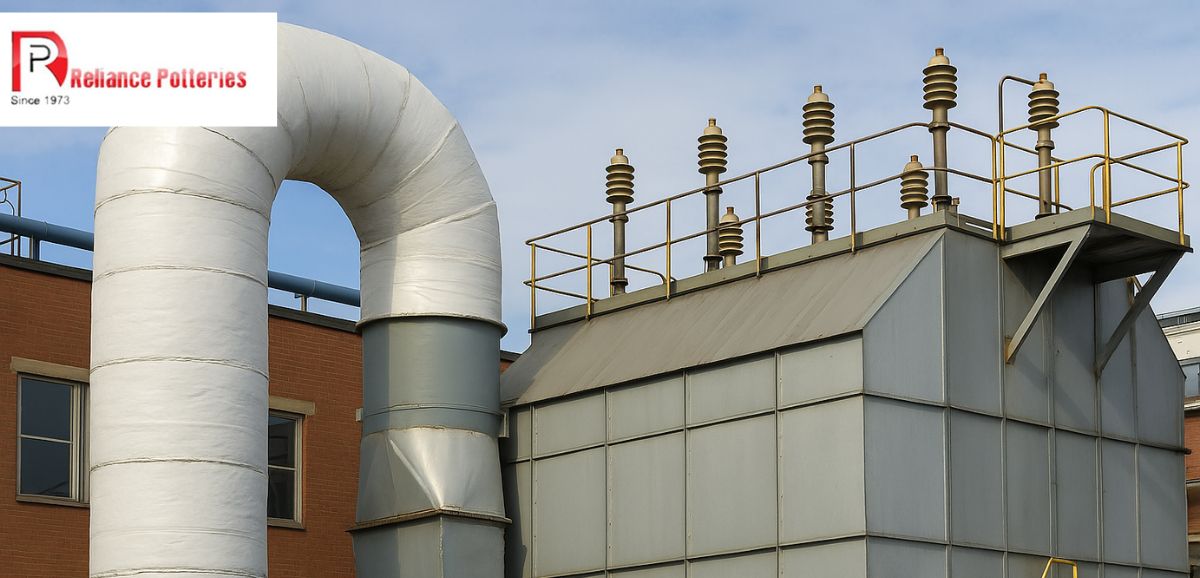
In the bustling world of the textile manufacturing industry, dyeing, finishing, and printing are responsible for generating a significant amount of airborne pollutants. It is vital to control the air pollution generated by the textile manufacturing industry. To achieve this, the textile industry is focusing on the introduction of functional air filtration systems, such as ESPs or electrostatic precipitators. ESP is a unique air filtration system, but another vital component that supports overall efficiency and mitigates air pollution in the textile industry is the insulation system.
The textile manufacturing industry consistently seeks the best ESP insulator manufacturer to obtain premium-quality ESP insulators. In this blog, we will compare ESP insulators and traditional insulation for textile air filtration, providing necessary feedback on which one is more suitable for operational efficiency in textile mills.
What Do You Understand by ESP Insulators
ESP insulators are a type of high-voltage electrical insulator used in electrostatic precipitators. The design of the ESP insulator is unique, electrically isolating live components from grounded structures while protecting against dust, heat, and corrosive elements commonly found in textile mills. Without an ESP insulator, the ESP cannot generate the electrical fields essential to trap airborne pollutants.
What Do You Mean by Traditional Insulation?
Traditional insulation primarily refers to thermal or electrical barriers derived from materials such as fiberglass, rubber, and mica. Traditional insulation mainly prevents heat loss and controls electrical flow in low- to medium-voltage environments. Conventional insulation systems are not suitable for high-voltage air filtration systems. Traditional insulation is also a crucial component in textile mills, serving to protect high-voltage wires and cables.
Comparison between ESP Insulator and Traditional Insulation
In this segment, we will discuss the significant difference between ESP insulator and traditional insulation.
1. Voltage handling
- ESP insulator- ESP insulator is mainly helpful for high voltage operation, which is up to 100kV
- Traditional insulation- Traditional insulation is helpful in managing low- to medium-voltage operations.
2. Application
- ESP insulators-ESP insulator is particularly useful for air filtration
- Traditional insulation- Traditional insulation is helpful for general heat and electric control systems
3. Lifespan
- ESP Insulator- It is long-lasting even in harsh weather conditions
- Traditional insulation- Traditional insulation tends to degrade faster degradation
4. Functional approach for air filtration
- ESP insulator- The ESP insulator is integrated with ESP, which is suitable for air filtration
- Traditional insulation- A traditional insulator, or traditional insulation system, is not suitable for an air filtration system.
Purposes of Choosing ESP Insulators for Textile Air Filtration
If you are planning to choose between ESP insulator and traditional insulator for your textile mills, you must select ESP insulator from a reliable insulator supplier in India for the following reasons: let’s discuss-
1. Support a high-voltage environment
Textile mills primarily use ESP insulators to manage high-voltage operational risks and airborne particulates.
2. Work efficiently in a harsh climate
The textile manufacturing industry primarily operates in a humid, dusty, and chemically laden environment. The design of the ESP insulator is unique, enabling it to withstand harsh weather conditions and making it valuable and durable for the textile industry.
3. Minimise the downtime
If you maintain the ESP insulator properly, it offers a long service life and reduces costly downtime. Reducing maintenance downtime is vital to keeping the air filtration system running smoothly.
Conclusion
When the textile industry plans to control airborne pollutants and maintain operational efficiency, a functional and premium-quality ESP is an essential element. Reliance Potteries is the leading manufacturer and supplier of ESP insulators and traditional insulators for various industrial applications. To ensure the best quality and reliable insulation for your textile mill, please get in touch with us.