
Do you think that a cheap insulator really saves you money? In any industrial operation, every purchase decision faces a common question: whether the equipment will reduce operational costs. Actually, reducing operational costs remains a primary motive for every industrial unit; that’s why many choose low-priced insulators. But in reality, what looks like a cost-saving decision becomes a long-term financial burden.
In every industrial operation, insulators play a vital role in ensuring electrical safety, machinery performance, and operational integrity. When industrial units compromise with the insulator quality, it becomes a huge financial burden rather than a cost-saving. Thus, it is vital to buy top-quality insulators from a trusted insulator supplier to ensure smooth operations in industrial units.
Now, let’s explore this blog to understand the hidden cost of using low-grade insulators in industrial operations.
Many industries focus on cost-saving factors rather than on equipment quality. Now, let’s discuss in this section the hidden cost of using low-grade insulators for industrial operation.
Low-grade insulators lack adequate strength and electrical performance, which are essential to fulfil industrial demand. After several uses, a low-grade insulator may crack, degrade, or lose its insulating properties.
As a result, a sudden increase in electrical faults occurs, leading to more short circuits and causing damage to the system. Any equipment failure can lead to repair and replacement costs, as well as production losses.
An increase in industrial downtime can be one of the costliest expenses caused by poor-quality insulators. When an insulator fails unexpectedly, an industrial operation may be disrupted by the need for repair or replacement.
A few hours of downtime can result in production delivery delays, missed production targets, and excessive government penalties. Many industrial units have already experienced that buying cheap quality insulation can be expensive during a major operational shutdown.
Low-grade insulators mainly need frequent inspection, repair and replacement. The industrial maintenance team needs additional time to identify insulator failures, perform emergency repairs, and replace damaged insulators. These recurring maintenance tasks can significantly increase labour costs and decrease productivity in operational tasks.
In such a case, an industrial unit can buy a top-quality insulator from a reliable transformer bushing manufacturer. It can help industrial units to reduce operational costs.
Many industrial facilities focus on energy efficiency yet overlook the role of insulation quality. Low-grade insulators primarily contribute to current leakage, reduced electrical efficiency, higher power consumption, and increased operational expenses. These types of losses may seem small at the initial stage, but over time, they can significantly increase overall utility costs.
Top-notch-quality ceramic insulators primarily maintain electrical integrity, reduce unnecessary energy loss, and support efficient industrial operations.
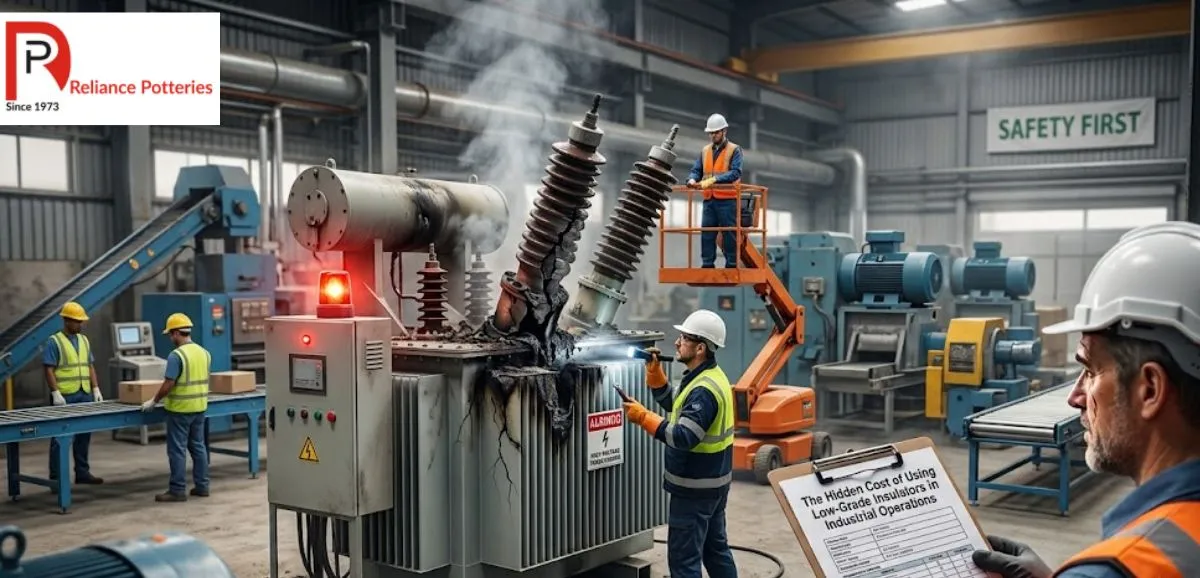
Compromising with industrial safety is non-negotiable. Industrial units can save operational costs by installing a poor-quality insulator. But do you ever realise what safety risks industrial units can face due to poor-quality insulators? It can significantly lead to sudden electrical flashovers, fire risks, equipment explosions, worker injuries, and government regulatory violations.
The financial impact of such industrial accidents caused by poor-quality insulators can be substantial, and they can also cause significant human loss. Choosing a top-grade insulator can create a safe working environment while maintaining the industrial safety standard.
By compromising on insulator quality, industrial units can incur significant financial losses. When evaluating an insulation solution, industrial units must focus on quality rather than price. If your industrial unit is looking for a high-performance insulator to ensure long-term value, Reliance Potteries can be your trusted solution.